Slave Legacy Still Haunts Angola and America

This year marks the 400th anniversary since the first enslaved Africans set foot in what is now the United States.  The arrival in the British colony of Virginia in August 1619 of a ship carrying Africans from Angola marked the start of more than 200 years of slavery in America. VOA’s Mayra de Lassalette and Betty Ayoub traveled to Angola to learn more about one of the origins of the trans-Atlantic slave trade and its lingering impact on the region.  Mayra de Lassalette narrates their report.

From: MeNeedIt

Sudanese Cautiously Cheer Power-Sharing Deal

Sudan’s Transitional Military Council and opposition coalition finalized a power-sharing agreement Sunday that aims to stabilize the country for the first time since the military ousted Omar al-Bashir in April after months of mass demonstrations. 

The final agreement came after weeks of tense talks and repeated attacks on pro-democracy protesters by TMC security forces. 

Thousands of protesters flooded the streets of Khartoum on Sunday to celebrate the signing of the deal.

Israa Mohamed applauded the agreement, saying it will be a base for a civilian country. However, he added, the only thing that guarantees the agreement’s success is to keep an eye on the revolution demands. 

Sudanese celebrate following a signing ceremony in the capital Khartoum, Sudan, Aug. 4, 2019.

Protester Abdallah Ali has been demanding political change since December. He said the agreement is a step forward, but not the end of the journey. 

“Signing the constitutional draft was an important step to resolve the political turmoil, but it was not our ultimate goal,” he said.

The military and opposition agreed the transitional decision-making body, known as the sovereign council, will contain an equal number of military figures and civilians. The head will be a civilian with a military background. 

The sovereign council will be established Aug. 20, with the TMC being dissolved on the same day. 

Analyst Mohamed Abdurrahman believes the agreement is a crucial step to resolve Sudan’s political crisis, but is concerned about the division between forces in the transitional period.

In addition, he’s worried the peace process might be hurt by armed movements resisting the agreements, including rebel groups in Sudan’s Darfur, Blue Nile and Nuba Mountain regions, which battled for years against the Bashir regime.  

There is also uncertainty regarding the pro-Bashir group called the Revolutionary Front and its reaction to a new, unelected government in Khartoum. 

From: MeNeedIt

France, Germany Condemn Russia Protest Crackdown

France and Germany on Sunday condemned a Russian police crackdown on a banned opposition rally that saw hundreds detained, with Paris criticizing an “excessive use of force” after a second weekend of protests over the exclusion of opposition candidates from local Moscow polls next month.

Berlin said the police action on Saturday “violated” Russia’s international obligations and undermines the right to fair elections in the country.

The arrests on Saturday were “out of all proportion to the peaceful nature of the protests against the exclusion of independent candidates” from city elections in Moscow, the German government said.

Crowds had walked along the capital’s central boulevard in a protest “stroll” over the refusal by officials to let opposition candidates run in September polls for city parliament seats — a local issue that has turned into a political crisis.

Police say 1,500 people took part in the demonstration.

AFP observed dozens of arrests along the route, as police formed human chains and grabbed people indiscriminately.

Sobol detained again

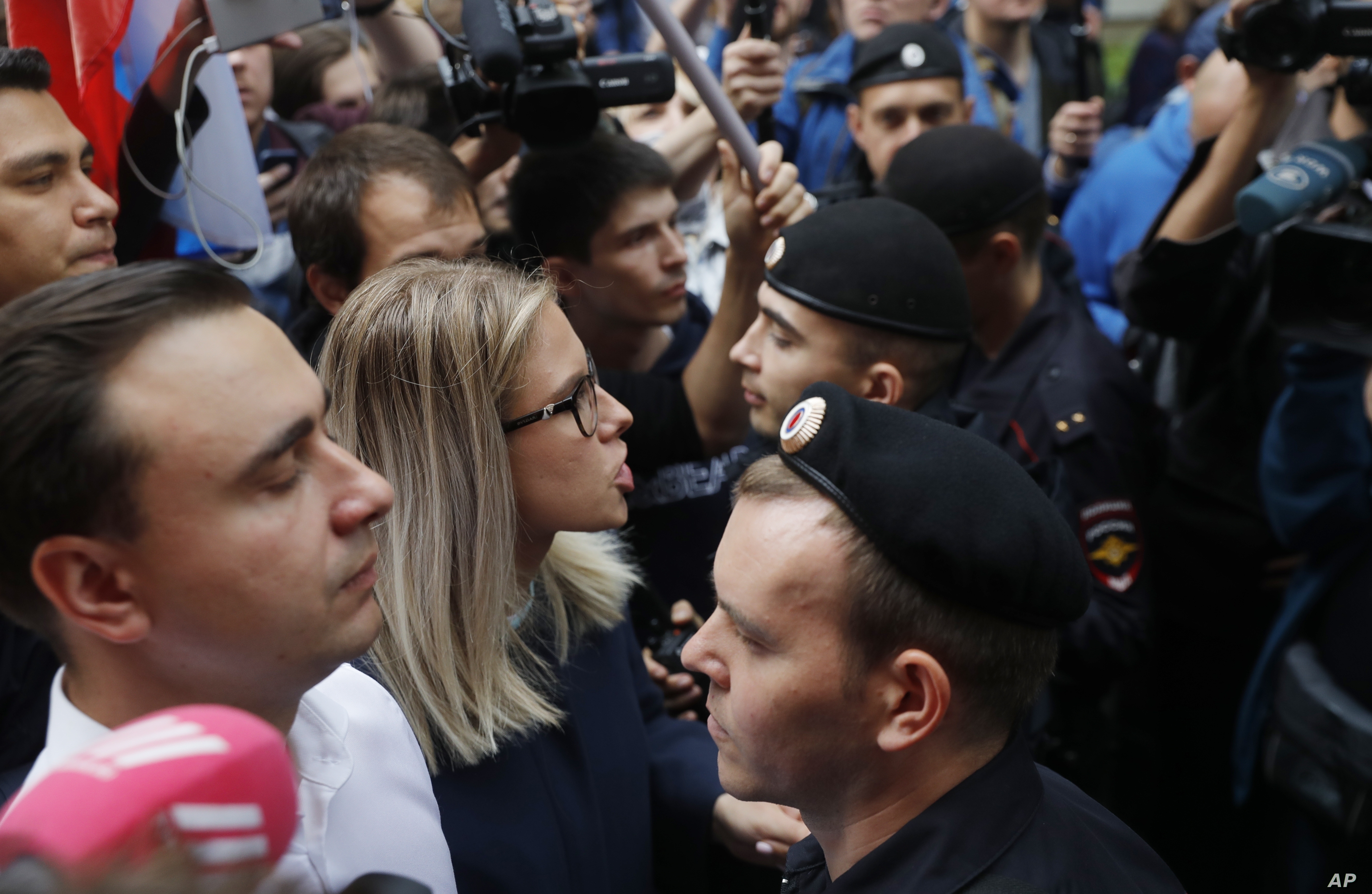
An ally of detained opposition leader Alexei Navalny, Lyubov Sobol, who is currently three weeks into a hunger strike after being barred from taking part in the election, was dragged from a taxi and detained as she set off for the rally.

FILE – Russian opposition candidate and lawyer at the Foundation for Fighting Corruption Lyubov Sobol, center, and others stand in front of a police line during a protest in Moscow, Russia, July 14, 2019.

Hours later she was taken to court where she was fined 300,000 rubles ($4,600) for a gathering on July 15, and held for further questioning over the protest last weekend, her team said.

A French foreign ministry spokesman said in a statement that Paris “insists on freedom of expression in all its forms, including that of demonstrating peacefully and taking part in free and transparent elections.”

France “calls on Russia to immediately free the people incarcerated in recent days and to conform to its commitments as a member of the OSCE and the Council of Europe,” the statement said.

Berlin condemned “the repeated interference in the guaranteed right to peaceful assembly and freedom of expression” which “violates Russia’s international obligations and strongly questions the right to free and fair elections”.

Sunday’s statements from Berlin and Paris follow an appeal last Monday calling on Moscow to release 1,400 other protesters detained after a similar demonstration on July 27.

FILE – A handout image made available on the official website of Russia’s opposition leader Alexei Navalny (Navalny.com) July 29, 2019, shows him sitting on a hospital bed in Moscow.

Navalny criminal probe

According to the independent protest monitor OVD-Info, some 828 people were detained during the latest rally on Saturday in Moscow.

Authorities also upped the pressure on Navalny, a top Kremlin critic, by launching a criminal probe into his anti-graft group on Saturday.

Navalny was rushed from his cell to hospital last weekend in an incident his personal doctor said could be poisoning with an unknown chemical substance.

A state toxicology lab said no traces were found.

President Vladimir Putin has yet to comment on the situation in Moscow.


From: MeNeedIt

African Teens Inspired, Motivated by Basketball Without Borders

For one intense week, 40 boys and 20 girls from 29 African countries were chosen for a highly selective program to train with current and former players from the National Basketball Association (NBA) and Women’s National Basketball Association (WNBA). 

The NBA’s Basketball Without Borders program has been scouting and training girls and boys across the continent for 17 years. Teenage girls who took part say working with women from the continent who played for WNBA teams has motivated them to stay in the game. 

Iris was scouted by the program from her local team in Gabon. (E. Sarai/VOA)

“This experience has been so enriching for us,” Iris, a 16-year-old from Gabon, told VOA. “It’s helped me a lot, I’ve learned new things and it’s renewed my enthusiasm, my desire to keep going and to become someone in the world of basketball.”

Iris says she was scouted for the program by organizers who watched her local team play in Gabon. Iris was then asked to produce a video of her playing and was later informed that she’d been accepted to the program.

The coaches and mentors are helping these young players through drills and matches, but also serve as role models of what the youngsters can become. One such role model is Astou Ndiaye, originally from Senegal. She played for the Detroit Shock, which won the 2003 WNBA championship.

“We have walked the path that they want to walk,” Ndiaye told VOA. “So just being here being able to talk to them, answer their questions and really give them hopefully, the confidence they need to know that if we can do it, they can because there’s a path for them.”

Ndiaye has been coaching young women in the Basketball Without Borders program for years, but is particularly encouraged this year because it is only the second time that Senegal has hosted the program in its 17-year history.

Ndiaye’s presence and enthusiasm for the program have been particularly inspirational for many young women who hope to follow in her footsteps.

Vanessa, a 16-year-old basketball player from Cameroon, says she is looking forward to returning home and sharing what she has learned at Basketball Without Borders. (E. Sarai/VOA)

“It’s because of them — they’ve inspired us to play basketball, really,” Vanessa, a 16-old player from Cameroon, told VOA. “And it’s because of them that we really apply ourselves here and say that maybe one day we can replace them, or play with them.”

Although only half as many girls as boys are accepted to the program, organizers say that promoting young female players on the continent is just as important to them as working with the boys.

“Our primary mission and goal at NBA Africa, when we launched, was to really increase participation in our sport. So you cannot do that by ignoring more than half the population,” Amadou Gallo Fall, NBA Africa’s managing director, told VOA. “So I think over the years, we’ve seen tremendous progress in the women’s game.”

The NBA sponsors the Basketball Without Borders program each year to scout and train up and coming basketball players on the continent. (E. Sarai/VOA)

Ndiaye agrees that in recent years, the women she coaches will have better opportunities than her generation did.

“It’s getting better. If we remember, we were pioneers then,” Ndiaye said.

“And the salaries, all the benefits and advantages that the kids are getting now — it’s unbelievable — so it can only get better.”
 

From: MeNeedIt

Pakistan Alleges India Used ‘Cluster Munitions’ in Cross-Border Fire

Pakistan has accused rival India of breaching international humanitarian laws by using “cluster munitions” in the latest cross-border skirmishes in Kashmir, saying the weapons killed at least two civilians and injured 11 others on the Pakistani side of the divided region.

The allegations come a day after India again rejected U.S. President Donald Trump’s offer to mediate a resolution of the Kashmir dispute between the two nuclear-armed countries.

A statement by Pakistan’s military said Saturday the civilian casualties occurred on July 31 in the scenic Neelum Valley near the Line of Control (LoC), the defacto border separating Pakistani and Indian portions of the disputed Himalayan territory.

It alleged the Indian army used cluster ammunitions delivered by artillery on July 31 in the valley, deliberately targeting the civilian population.

Cluster munitions are weapons consisting of a container that opens in the air and scatters a large number of explosive submunitions over a wide area. The related global convention adopted in 2008 prohibits the use of cluster munitions.

There was no immediate reaction from India to the allegation. Indian authorities for their part also accuse Pakistani forces of indulging in unprovoked cross-border shelling, causing civilian and military casualties on their side

Map of the Line of control, Kashmir

The Pakistani military statement urged the international community “to take notice of this Indian blatant violation of international laws on use of cluster ammunition targeting innocent citizens.”

It also released pictures of victims and the purported weapons it said were used by Indian forces. Independent verification was difficult to ascertain.

Trump Reiterates Kashmir Mediation Offer

Speaking together with visiting Pakistani Prime Minister Imran Khan at the White House two weeks ago, Trump said that Indian Prime Minister Narendra Modi had recently asked him whether he would like to be a mediator or arbitrator on Kashmir, assertions New Delhi swiftly denied.

Trump, however, reiterated his mediation offer on Thursday, saying he is willing to mediate but a decision would be up to Modi and Khan.

“If I can — if they wanted me to, I would certainly intervene,” Trump told reporters.

Indian Minister for External Affairs S. Jaishankar said he told U.S. Secretary of State Mike Pompeo on the sidelines of an Asian security forum in Bangkok that any discussion of the disputed Kashmir region would be strictly between India and Pakistan.

New Delhi has long opposed outside attempts to mediate its dispute with Pakistan over Kashmir. Islamabad insists international help is required because of persistent Indian refusals to engage in bilateral talks.

Security Alert in Indian Kashmir

Saturday’s Pakistani allegations come as thousands of people, mostly, visitors, reportedly have started leaving the India-ruled portion of Kashmir since the local government warned of possible militant attacks.

Indian authorities announced Friday they had found evidence of attacks by militants allegedly backed by Pakistan on a major Hindu pilgrimage in Kashmir. The revelation prompted the regional government to order the pilgrims and tourists to return home.  

Regional military tensions have remained high since February 14, when a vehicle-born bomb rammed into an Indian paramilitary convoy in Kashmir, killing 40 security personnel and triggering an aerial dogfight between Indian and Pakistani air force planes. New Delhi blamed Pakistan-based militants for plotting the attack. The subsequent escalation in tensions brought India and Pakistan to the brink of a fourth war before international diplomatic intervention helped defuse the situation.

New Delhi has suspended official talks with Islamabad since Modi came to power in 2014, demanding Pakistan first stop militants plotting cross-border attacks in India.

Separatist violence and the ensuing Indian crackdown are estimated to have killed more than 70,000 people in Indian Kashmir.


From: MeNeedIt

US: Resolved Extortion Case Key to N. Macedonian EU Accession Talks

This story originated in VOA’s Serbian Service. Some information is from Reuters.

WASHINGTON — U.S. Deputy Assistant Secretary of State Matthew Palmer says an unresolved extortion investigation in North Macedonia could undermine prospects for the small Balkan nation’s long-awaited European Union accession talks.

North Macedonia’s former chief Special Prosecutor, Katica Janeva, unexpectedly tendered her resignation last month amid allegations that she masterminded a scheme to extort millions from an indicted businessman in exchange for a reduced sentence.

Janeva’s Special Prosecution Office (SPO), an organized-crime-busting outfit also tasked with addressing high-level corruption, has long been emblematic of the former Yugoslav republic’s transatlantic aspirations. By spearheading investigations of the now-ousted authoritarian regime of former Prime Minister Nikola Gruevski, Janeva’s office was largely mandated to restore rule of law.

“These are serious charges and all such serious charges require a serious response,” Palmer told VOA’s Serbian Service. “We support a complete, thorough, transparent investigation of these charges and, if the evidence is there, then appropriate prosecution. This is really an opportunity for the authorities in North Macedonia to demonstrate fealty to adherence to the rule of law.”

FILE – Newly elected President of North Macedonia Stevo Pendarovski, right, walks with outgoing president Gjorge Ivanov, during his inauguration ceremony in Skopje, North Macedonia, May 12, 2019.

The country changed its name from Macedonia to North Macedonia in February, ending a more than two-decade dispute with Greece over its name, and removing an obstacle to EU and NATO membership.

Just last week, EU commissioner Johannes Hahn said Skopje needs to reform the judiciary to ensure it can handle high-level crime and corruption cases before the EU can set a date to start accession talks, but that he was “confident that the decision (on the start of EU accession talks) will be taken in October.”

Palmer said he’s optimistic talks can begin this fall, but that resolving the Janeva investigation will be key to ensuring it happens.

Both of North Macedonia’s major political parties have been squabbling over the drafting of a law to regulate the prosecution, which will determine the fate of the special prosecutor’s office that Janeva used to run.

“We believe that North Macedonia has earned that opportunity [to have EU accession talks begin this year], but … signals that the government sends — and the success of the SPO law — will be important to that.”

FILE – Protesters take part in a demonstration near the Greek Parliament against the agreement with Skopje to rename neighbouring country Macedonia as the Republic of North Macedonia, Jan. 20, 2019 in Athens.

Whether new legislation can be ratified, a precondition for EU accession talks, will determine the pace of North Macedonia’s European accession process, which is why both U.S. and EU officials have repeatedly pressed both parties, the right-wing opposition VMRO-DPMNE and ruling Social Democratic Union, to come to an agreement.

Meetings between party officials earlier this week produced indications of progress, but working groups are still in negotiations.

“It’s important that these parties come together, negotiate, resolve their differences and reach an agreement on how the SPO can be reformed or modified in a manner that advances the interests of the country,” Palmer told VOA.

“There’s been enough politicking. The time for politicking is over. Now is the time for statesmanship,” he said.

From: MeNeedIt

Butterfly Populations Reflect Health of Wetlands

There are 48 insects included on the U.S. Endangered Species List, and the only way any insect has ever come off the list is through extinction. This is especially troubling for the world’s butterfly populations, which have declined by 20% in the last decades. Erika Celeste takes us to visit one of the rarest wild butterfly populations in the world, the Mitchell’s satyr butterfly at the Sarett Nature Center in Benton Harbor, Michigan.
 

From: MeNeedIt

Sources: Boeing Changing Max Software to Use 2 Computers

Boeing is working on new software for the 737 Max that will use a second flight control computer to make the system more reliable, solving a problem that surfaced in June with the grounded jet, two people briefed on the matter said Friday. 
 
When finished, the new software will give Boeing a complete package for regulators to evaluate as the company tries to get the Max flying again, according to the people, who didn’t want to be identified because the new software hasn’t been publicly disclosed. 
 
The Max was grounded worldwide after crashes in Indonesia and Ethiopia that killed a total of 346 people.  
  
Use of the second computer, reported Thursday by The Seattle Times, would resolve a problem discovered in simulations done by the Federal Aviation Administration after the crashes. The simulations found an issue that could result in the plane’s nose pitching down. Pilots in testing either took too long to recover from the problem or could not do so, one of the people said. 
 
In the new configuration, both of the plane’s flight control computers would be monitored by software, and pilots would get a warning if the computers disagreed on altitude, air speed and the angle of the wings relative to the air flow, the person said. Only one computer was used in the past because Boeing was able to prove statistically that its system was reliable, the person said.  
  
The problem revealed in June is like the one implicated in the two crashes. That problem was with flight-control software called MCAS, which pushed the nose down based on faulty readings from one sensor. MCAS was installed on the planes as a measure to prevent aerodynamic stalling, and initially it wasn’t disclosed to pilots. 

‘More robust’ system
 
The new software would make the entire flight-control system, including MCAS, rely on two computers rather than one, said the person. “It would make the whole flight control system more robust,” the person said. 
 
Boeing Co. spokesman Charles Bickers said only that the company is working with the FAA and other regulators on software to fix the problem that surfaced in June. The company has said it expects to present the changes to the FAA and other regulators in September, and it hopes the Max can return to flight as early as October.  
  
The two people briefed on the matter said Boeing has finished updating the MCAS software by scaling back its power to push the nose down. It is also linking the software’s nose-down command to two sensors on each plane instead of relying on just one in the original design. 
 
The FAA has been widely criticized for its process that certified the Max as safe to fly, largely because it uses company employees to do inspections that are then reviewed by the agency.  

From: MeNeedIt

Trump’s Pick for National Intelligence Director Withdraws

WASHINGTON — President Donald Trump says his pick for national intelligence director has decided to withdraw from the running, citing unfair media coverage. 
 
In a tweet Friday, Trump said Republican Representative John Ratcliffe of Texas had decided to stay in Congress. Questions about Ratcliffe’s experience had dogged him since Trump announced his candidacy Sunday. 
 
Trump didn’t cite any specific media reports but tweeted that “rather than going through months of slander and libel,” Ratcliffe would be returning to Capitol Hill.  
  
Trump accepted the resignation of former Director of National Intelligence Dan Coats last week.  
  
Ratcliffe is a frequent Trump defender who fiercely questioned former special counsel Robert Mueller during a House Judiciary Committee hearing last week. Intelligence experts had criticized his lack of experience in the field of intelligence.  
  
In a statement, Ratcliffe said, “While I am and will remain very grateful to the president for his intention to nominate me as director of national intelligence, I am withdrawing from consideration.” 
 
“I was humbled and honored that the president put his trust in me to lead our nation’s intelligence operations and remain convinced that when confirmed, I would have done so with the objectivity, fairness and integrity that our intelligence agencies need and deserve,” the statement said. 
 
“However,” he added, “I do not wish for a national security and intelligence debate surrounding my confirmation, however untrue, to become a purely political and partisan issue.” 

From: MeNeedIt

Nigeria’s Buhari Faces Flak Over Cabinet Picks

Nigerian President Muhammadu Buhari has come under fire for stacking his new cabinet with ageing party loyalists despite hopes he might opt for more technocrats in his final term.

The senate this week approved the list of 43 ministers after the former military ruler finally settled on their names some two months after his inauguration in May.

Buhari, 76, is yet to hand out their portfolios but already his choice of stalwarts from his All Progressives Congress (APC) party has caused dismay.

“One would have expected that the president would shop for more people with more expertise” to assuage worries about the future, said Abiola Akiyode-Afolabi, head of Abuja-based Transition Monitoring Group organisation.

She said she doubted the ability of those chosen “to push the agenda for development for Nigeria”.

Buhari faces a raft of challenges in his second term at the helm of Africa’s most populous nation — from tackling a grinding Islamist insurgency and spreading insecurity to trying to bolster a fragile economic recovery.

During his first four years he earned the nickname “Baba go-slow” after he took six months to name a cabinet and was seen to proceed with decisions at a glacial pace.

Far from cutting lose for his second, and final stint in power, he now appears to have fallen back on familiar faces.

In a country with more than half the population under 30, not one of the ministers is less than 40 years old.

Only seven of those chosen are women.

“16.3 percent representation is abysmal,” Ndi Kato, a 28-year-old female politician told local media.

“We have an abundance of qualified women and we have been advocating throughout the process of selecting ministers. The disrespect of tossing out the requests of women like it doesn’t matter is traumatic.”

‘More patronage’

Analysts said the decision to reward loyalists and keep key players in place means there are unlikely to be major reforms in the years ahead.

Fourteen of the ministers in the new cabinet served Buhari during his first term from 2015 to 2019.

Among those coming back are heavyweights like Babatunde Fashola, a former Lagos governor, transport minister Rotimi Amaechi, who ran oil-rich Rivers state, finance minister Zanaib Ahmed, foreign minister Geoffrey Onyema and education minister Adamu Adamu.

“Rewarding APC powerbrokers will improve party cohesion in the second term but also risks eroding first-term gains in curbing patronage,” said the Eurasia consultancy group in a note.

The president appeared to be prioritising APC unity and making up for 2015 when some leading backers in the party complained they had been overlooked, the group said.

“It also signals to party officials that Buhari will condone more patronage and possible leakages from government coffers than during his first term,” it said.  

The opposition People’s Democratic Party (PDP), which is still challenging Buhari’s election victory, has been quick to criticise the government selection as uninspiring and unable to tackle the challenges ahead.  

“In recycling failed yesterday’s men for today’s assignment, President Buhari and the APC have left no one in doubt that they have no vision to move our nation out of the economic and security predicaments into which they have plunged us in the last four years,” the party said in statement.

Rooting out graft

Anti-graft crusaders also worried that the appointments did not look promising for attempts to seriously tackle Nigeria’s endemic corruption.

Rooting out graft was one of Buhari’s big pledges in 2015 and he has promised to step it up this time round.

But critics have accused him of using the corruption crackdown to target his political opponents.

Debo Adeniran of the Coalition Against Corrupt Leaders (CACOL) pressure group, pointed to new ministers with major questions hanging over them.

Although Adeniran did not give their names, Fashola has been asked by CACOL to step down over fraud allegations while at the helm in Lagos.

Goodwill Akpabio, a former opposition leader, senator and governor of southern oil-rich Akwa Ibom state who defected to Buhari’s ruling party ahead of the 2019 elections has also faced accusations of looting his state treasury.

Another name is former information minister Lai Mohammed, who has been summoned by a court to clear his name over a phony contract awarded in his department.

“I don’t think there was due diligence on the nominees. Otherwise, the president would not have considered many of them,” Adeniran said.

“For Buhari’s integrity and fight against corruption to be taken serious, he has to do away with many of his appointees.”


From: MeNeedIt

Former Ebola Patients to Mark 5 Years Since Treatment in US

As a new Ebola outbreak rages in Congo, two of the first Ebola virus patients to be successfully treated in the United States during the deadliest recorded outbreak five years ago are reuniting with their doctors.

Dr. Kent Brantly and Nancy Writebol were among the four Americans who were treated and recovered at Atlanta’s Emory University Hospital in 2014.

They plan to join Emory medical staff for a media briefing on Friday, the fifth anniversary of Brantly’s arrival. He was the first to come to Emory after being infected while working in Liberia.

A third former patient, Dr. Ian Crozier, had planned to join them but is back in Congo, helping to fight the current outbreak.

The outbreak in Congo is the second deadliest recorded and has already killed more than 1,800 people, nearly a third of them children.

The 2014-16 outbreak in West Africa killed more than 11,300 people.

From: MeNeedIt