Advertising and marketing. Advertising is the practice and techniques employed to bring attention to a product or service. Advertising aims to put a product or service in the spotlight in hopes of drawing it attention from consumers
Relentless global warming threatens the potential success of a sweeping set of goals established by the United Nations to tackle inequality, conflict and other ills, officials said on Tuesday.
Climate change imperils food supplies, water and places where people live, endangering the U.N. plan to address these world problems by 2030, according to a report by U.N. officials.
Member nations of the U.N. unanimously adopted 17 global development goals in 2015, setting out a wide-ranging “to-do” list tackling such vexing issues as conflict, hunger, land degradation, gender inequality and climate change.
The latest report, which called climate change “the greatest challenge to sustainable development,” came as diplomatic, business and other officials gathered for a high-level U.N. forum to take stock of the goals’ progress.
“The most urgent area for action is climate change,” said Liu Zhenmin, U.N. Under-Secretary General for Economic and Social Affairs, in the report.
“The compounded effects will be catastrophic and irreversible,” he said, listing increased extreme weather events, more severe natural disasters and land degradation. “These effects, which will render many parts of the globe uninhabitable, will affect the poor the most.”
Progress has been made on lowering child mortality, boosting immunization rates and global access to electricity, the report said.
Yet extreme poverty, hunger and inequality remain hugely problematic, and more than half of school-age children showed “shockingly low proficiency rates” in reading and math, it said.
Two-thirds of those children were in school.
Human trafficking rates nearly doubled from an average 150 detected victims per country in 2010 to 254 in 2016.
But it was unclear how much of the increase reflected improved reporting systems versus an increase in trafficking, said Francesca Perucci of the U.N.’s statistics division, who worked on the report.
“It’s hard to exactly distinguish the two,” she said at a launch of the report.
But climate change remained paramount.
Greenhouse gases have continued to climb, and “climate change is occurring much faster than anticipated,” the report said.
At this week’s goals summit, 47 countries were expected to present voluntary progress reviews. Almost 100 other countries and four cities including New York have done so.
Earlier U.N. reports said the goals were threatened by the persistence of violence, conflict and lack of private investment. Outside assessments have also cited nationalism, protectionism and insufficient funding.
The cost of implementing the global goals has been estimated at $3 trillion a year.
In the Dutch port city of Rotterdam, nine “water plazas” have been created that soak up excess rainfall while offering people a green space to meet and children to play.
The city is also planting gardens and putting solar panels on a growing area of its nearly 20 square kilometers (8 square miles) of flat roofs.
Paris, meanwhile, is redesigning and opening green schoolyards as cooler places for locals to escape extreme heat, while in New Zealand, Wellington is rolling out neighborhood water supplies to keep the taps on when an earthquake hits.
More than 70 cities that are part of the 100 Resilient Cities (100RC) network, set up in 2013, have crafted “resilience strategies” that include about 3,500 activities designed to combat shocks and stresses – everything from floods to an influx of refugees.
The United Nations estimates that by 2050 nearly 70% of the world’s population will live in cities, which are increasingly impacted by extreme weather and sea level rise, while producing about 75% of planet-warming emissions.
Michael Berkowitz, president of 100 Resilient Cities, told a gathering of the network’s cities in Rotterdam on Tuesday that efforts to build resilience had now become established as an approach to improving quality of life in cities.
Those efforts to keep people safe and well in the face of rising climate, economic and social pressures will continue, despite the closure this month of the organization that helped them craft those plans, officials said.
At the end of July, 100RC will shut its offices after the New York-based Rockefeller Foundation said in April it would no longer fund the body, having given about $176 million for its work.
That funding helped pay initial salaries for chief resilience officers in member cities, for example, though about 80% of the cities now have made the role a part of their staff, 100RC officials said.
The Rockefeller Foundation said on Monday it would provide an additional $8 million over 18 months to help 100RC cities and their chief resilience officers transition to a network they will lead themselves.
“Ultimately, we aim to ensure continued collaboration and sharing among cities to address some of their most pressing challenges,” Rockefeller Foundation President Rajiv Shah said in a statement.
Expansion Ahead?
Krishna Mohan Ramachandran, chief resilience officer for the Indian city of Chennai, which has just launched its resilience strategy, said he was relieved it would be able to carry on with planned projects.
Those include conserving scarce water, putting vegetable gardens in schools, and finding less risky but nearby locations for flood-threatened communities, among others.
Rotterdam chief resilience officer Arnoud Molenaar, who led colleagues in lobbying for extra funding from the Rockefeller Foundation, said resilience work had garnered more support and created more value in cities than was often appreciated.
The Rockefeller bridge grant meant the network would now have time to raise more money from donors and others to stand on its own, and expand partnerships with politicians, communities and businesses, Molenaar said.
Elizabeth Yee, who moved from 100RC to The Rockefeller Foundation to manage its climate and resilience work, said there was a “huge” amount of money looking for resilient urban infrastructure projects, but cities often struggled to meet investor requirements.
She said a key to finding funding was to design a bus rapid transit system or a clean power plant, for example, to also create local jobs and make communities more economically secure.
“I am hopeful that we can keep helping cities develop those projects and getting them ready for bigger, broader investment,” she told the Thomson Reuters Foundation on the sidelines of the conference in Rotterdam.
Cities in the 100RC network have so far raised $25 billion from their own budgets, businesses and other sources to put their resilience plans into practice, 100RC’s Berkowitz said.
In a decade’s time, he said, he hoped urban resilience – with its holistic approach to multiple, modern-day stresses – would have become “an absolutely essential part of city government.”
For now, as cities rapidly expand and climate threats grow, much more such work will be needed, he said.
“Even 100 cities is a ridiculously small number of cities, compared to the world’s 10,000 cities,” he said. “We need more effort if we’re going to really win the battle of the 21st century, which is going to be fought in cities.”
The organizers of the beleaguered Woodstock 50 festival said on Tuesday they still hoped to get a permit for the event due to take place next month despite being turned down at a second site.
Authorities in the town of Vernon in upstate New York turned down the organizers’ application to stage the three-day event, marking the 50th anniversary of the famed 1969 “peace and music” festival.
Oneida County Administrator Anthony Picente Jr. told Hollywood trade publication Variety that efforts to stage the festival at Vernon Downs for some 65,000 people at short notice had been “chaotic.” Picente said he thought the chances of it taking place were “highly unlikely.”
However, Woodstock 50 producers said they would appeal.
“With a venue chosen, financing assembled and many of the artists supporting Woodstock’s 50th Anniversary event, the organizers are hopeful that their appeal and reapplication” will prevail, the producers said in a statement.
Tickets have yet to go on sale.
The Aug. 16-19 festival was originally due to take place at the Watkins Glen motor racing venue in upstate New York with a line-up including Jay-Z and Miley Cyrus.
Watkins Glen in June pulled out, throwing the festival into further uncertainty after the original investors withdrew their support, citing problems with permits and arranging security and sanitation.
Woodstock 50 announced in March that more than 80 musical acts, including 1969 festival veterans John Fogerty, Canned Heat and Santana, would take part. Some 100,000 fans, including campers, were originally expected to attend, but that number was later reduced to 60,000.
Mexico’s moderate Finance Minister Carlos Urzua resigned on Tuesday with a letter that shocked markets by citing “extremism” in economic policy, before President Andres Manuel Lopez Obrador quickly named a well-regarded deputy minister to replace him.
In the unusually strongly worded resignation note made public on his Twitter account, Urzua said the government was forming economic policy without sufficient foundation.
“I’m convinced that economic policy should always be evidence-based, careful of potential impacts and free of extremism, either from the right or the left,” Urzua wrote. “These convictions did not resonate during my tenure in this administration,” Urzua said.
He also said there were what he called conflicts of interest in the appointment of some ministry officials imposed on him by influential members of the government. He did not give more details.
The Mexican peso fell over 2% on the news and the benchmark stock index slid almost 1.5%. Both recovered a little after Lopez Obrador quickly promoted Deputy Finance Minister Arturo Herrera to the top job.
Well known to investors and seen as a competent economic manager, Herrera now has the task of reviving economic growth while meeting a 1 percent primary budget surplus, kickstarting flagging investment and fending off downgrades from ratings agencies worried about indebted state-oil company Pemex.
“[Herrera] is a well-known figure with good dialogue with market participants and is not perceived as a … dogmatic individual,” said Alberto Ramos, head of Latin American research at Goldman Sachs.
“But in light of the unusual content of Urzua’s resignation letter there is out there the lingering question of who is ultimately in charge of running economic policy,” Ramos said.
Academic hawk
Urzua, a slightly disheveled former academic prone to mild verbal gaffes, was a very different finance minister from Mexico’s recent tradition of slick technocrats who spoke the language of Wall Street.
However, he was seen by markets as a moderate whose commitment to fiscal discipline was a bright spot in the administration of Lopez Obrador, which has frequently buffeted markets with surprise policy decisions.
Before the government took office on Dec. 1, Urzua was tasked with meeting with dozens of investment funds to convey that the government was center-left, rather than leftist.
On his watch, however, Urzua was hit by a sovereign debt downgrade and contracting economic growth as he stuck to fiscal targets while setting aside money to support Pemex and Lopez Obrador’s plans to splurge on a new oil refinery.
A 64-year-old economist, Urzua is an old friend of the president and served as his finance minister when Lopez Obrador was Mexico City’s mayor.
Urzua deeply cut back spending programs in a strategy aimed at cleaning out corruption and largesse with a new, more centralized model of assistance. He also began a program of centralizing procurement, in another drive for efficiency and clean government.
Both actions have been blamed for shortages in areas such as healthcare, where lack of medicines led to the high-profile resignation of the public health system chief earlier this year.
In a video message to announce his successor, Lopez Obrador said Urzua was not comfortable with the decisions being taken to upend what the president frequently calls the neoliberal era in Mexico, starting in the 1980s.
“We are committed to changing economic policy that has been imposed for the past 36 years,” Lopez Obrador said. “We can’t put old wine in new bottles.”
“We believe there will be economic growth, that we will progress in the country by fighting corruption and … with a policy of austerity,” the president said.
Governments and international organizations around the world have condemned last week’s bombing of a migrant detention center in Libya that killed more than fifty civilians and wounded at least 130. The horrific incident, however, has not deterred desperate migrants who still want to make the dangerous trip to Europe. VOA’s Heather Murdock is in Tripoli with this report.
The widely-publicized case of Baiq Nuril Maknun, the 41-year-old school bookkeeper sentenced to six months in prison for recording sexually-suggestive phone calls she received from the principal at her school, has gained traction after the Indonesian government indicated a willingness to grant her amnesty – which would eliminate any traces of wrongdoing from her part.
After a meeting in Jakarta with Nuril and her counsel on Monday, Indonesia’s Law and Human Rights Minister, Yasonna Laoly, told reporters an amnesty could be announced after Indonesia’s newly-elected president, Joko Widodo, through the state secretariat, discusses the legal proceedings with the House of Representatives. One of Nuril’s lawyers, Joko Jumadi, confirmed to VOA that they will meet with the House of Representatives Wednesday.
“I think it sounds to me like a green light,” he said. “We are optimistic. We have to be.”
Several law experts were also invited to the meeting, one of whom was Bivitri Susanti who confirmed to VOA that the president was indicated to have favored amnesty. Last week, Joko told reporters in Manado, a city on Sulawesi island, that though he would not intervene with the Supreme Court ruling, he advised that Nuril and her counsel apply for amnesty.
Talk of granting Nuril amnesty followed a controversial rejection of Nuril’s appeal from Indonesia’s Supreme Court last week – one that upheld her prison stay and a $35,000 (500 million rupiahs) fine.
Case history
Nuril’s case began in 2012, when Muslim (who, like many Indonesians, goes by one name), the newly-minted principal of her school in Mataram, called her repeatedly. In the phone calls, he used sexually inappropriate language and even went as far as to tell her about his own affair with his own treasurer. As word spread suggesting Nuril and Muslim had indeed embarked on an affair, Nuril determined to disprove the rumor to her colleagues by recording the call.
Learning of the recordings, Muslim reported Nuril to the police, citing a clause in Indonesia’s controversial electronic information and transactions law that presides over defamation. Deemed innocent by the local court (though she still went to prison during the investigation) in 2017, the prosecutors took it up with the Supreme Court who later convicted Nuril of defamation in 2018 and sentenced her to a six-month jail time.
Indonesia’s Law and Human Rights Minister Yasonna Laoly talks to journalists with Baiq Nuril Maknun, a school bookkeeper who was jailed after she tried to report sexual harassment, in Jakarta, Indonesia, July 8, 2019.
Her case has sparked outrage from activists and rights organizations. An online crowd-funding campaign has also been set up to help with Nuril’s fine (she would have to serve an additional three months in prison if she fails to pay the fine).
“From the very beginning, law enforcers have sided with versions of the story from the principal,” Usman Hamid, head of the Indonesia chapter of Amnesty International, told VOA. “They should be protecting Nuril as a victim, not brand her as a [convict].”
Nuril’s case reignited discussions on sexual assault cases. Joko, Nuril’s lawyer, told VOA that the Supreme Court ruling against his client set a “terrible precedent for future reports from sexual assault victims.” Her case came after Indonesia was embroiled in the discourse around the passing of the anti-sexual violence bill, which faced opposition from religious groups.
Amnesty v. clemency
Another potential legal means for Nuril is through clemency, though law expert Bivitri said that it would be unlikely. “Clemency is usually provided to people embroiled in extraordinary cases, say people sentenced to death or for life,” she said.
Amnesty, she said, would be the best way forward. “If the president grants Nuril amnesty, then it could prove that the government protects its citizens while honoring the judicial proceedings.” She added that amnesty would erase her criminal record. In contrast, the granting of clemency would mean that Nuril agreed that she was in the wrong and that she would ask for the leniency of her punishment.
“We don’t see any criminal wrongdoing here from her part,” Usman of Amnesty International said.
Indonesia’s former presidents have previously granted amnesty. In 1959, then president Sukarno granted amnesty and abolition to the people involved in the rebel group D.I/T.I.I. Kahar Muzzakar in South Sulawesi. In 2005, President Susilo Bambang Yudhoyono granted amnesty to the separatist movement in Aceh, Gerakan Aceh Merdeka.
“Joko could use this argument: for the sake of peace and humanity,” Usman said, before adding that history shows that amnesty has also been granted to individuals.
Sri Lanka’s government announced Tuesday it will reduce ground handling charges for airlines and slash aviation fuel prices and embarkation fees to help the country’s vital tourism industry recover after Easter suicide bombings killed more than 250 people.
Tourism Minister John Amaratunga said the decision will lead to an increase in flights to Sri Lanka and a reduction in ticket prices, which will attract more tourists to the Indian Ocean island nation, famed for its pristine beaches.
Seven suicide bombers from a local Muslim group, National Thowheed Jammath, attacked three churches and three luxury hotels on April 21, killing 258 people, including 45 foreigners mainly from China, India, the U.S. and Britain.
Tourist arrivals declined 57% in June from a year earlier, dealing a severe blow to the tourism industry, the country’s third-largest foreign currency earner after remittances from overseas workers and textile and garment exports.
The cuts in charges and fees will be in place for six months, said Johanne Jayaratne, head of the government’s tourism development agency.
About 2.3 million tourists visited Sri Lanka in 2018, when 29 airlines offered 300 flights per week. After the April 21 attacks, 41 fights per week were canceled, amounting to a loss of 8,000 passenger seats. Several airlines have reinstated their normal schedules since then, but others have not.
Dimuthu Tennakoon, chairman of the Board of Airline Representatives, said the government decision will encourage airlines to increase their capacity and offer attractive fares.
“That will definitely happen with this reduction because fuel and ground handling contribute a significant percentage of the total cost element of any airline,” he said.
Tourism accounts for 4.9% of Sri Lanka’s GDP. Around half a million Sri Lankans depend directly on tourism and 2 million indirectly.
The government currently predicts $3.7 billion in revenue from tourism this year, down from an initial forecast of $5 billion.
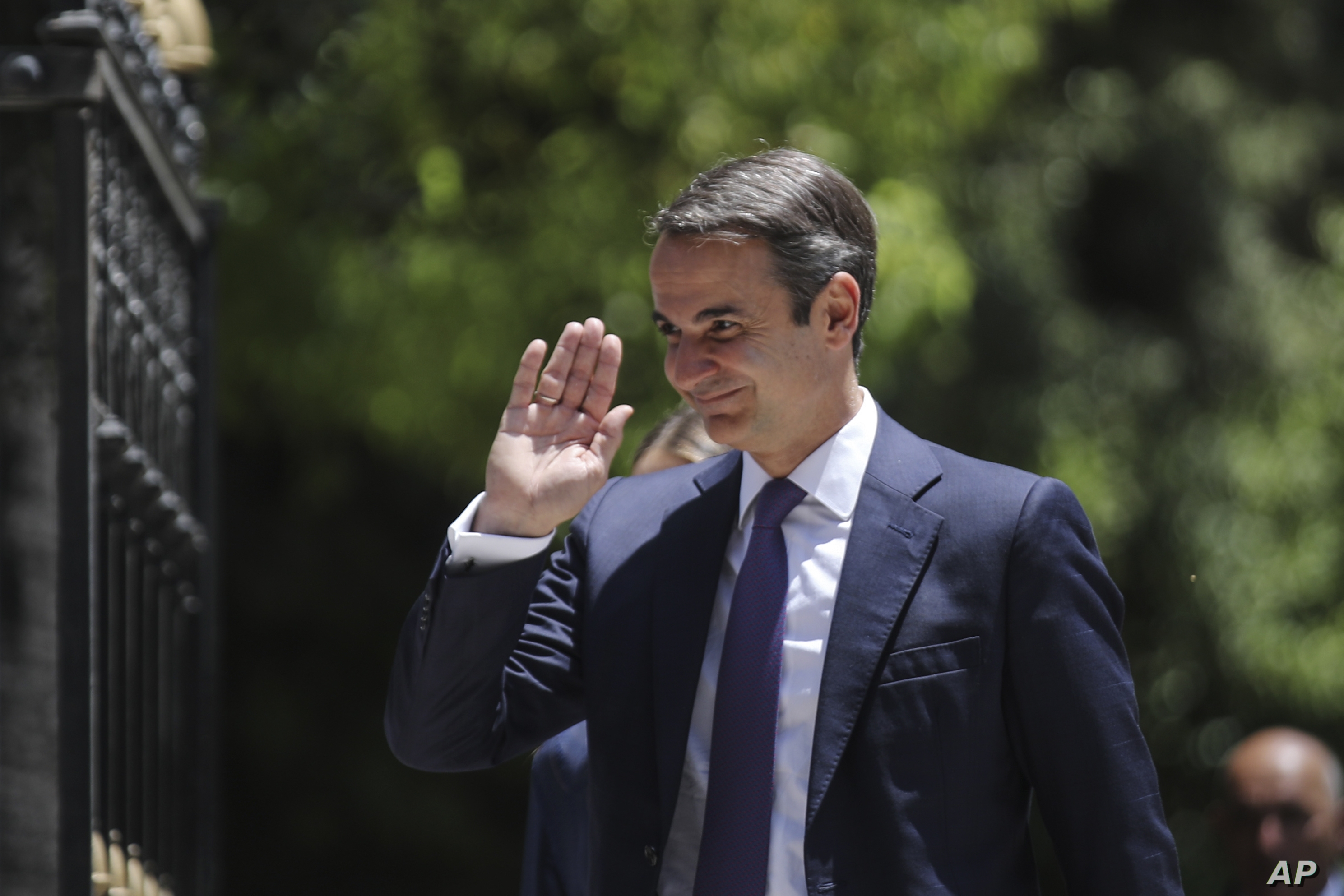
Greece’s new Cabinet was sworn in Tuesday, two days after conservative party leader Kyriakos Mitsotakis won early elections on pledges to make the country more business-friendly, cut taxes and negotiate an easing of draconian budget conditions agreed as part of the country’s rescue program.
The new Cabinet relies heavily on experienced politicians who have served in previous governments, but also includes non-politician technocrats considered experts in their fields.
FILE – Greece’s newly-elected prime minister Kyriakos Mitsotakis, waves as he walks shortly after his swearing-in ceremony at the Presidential Palace in Athens, July 8, 2019.
Mitsotakis appointed Christos Staikouras to the crucial post of finance minister. Staikouras is an economist and engineer who had served as deputy minister in a previous government.
The new foreign minister is Nikos Dendias, who held previous Cabinet positions in the ministries of development, defense and public order.
A former public order minister under a previous socialist government, Michalis Chrisohoidis, takes the reins of the ministry once again as one of Mitsotakis’ non-parliamentary appointees.
The new appointees headed to their ministries for official handovers after the swearing-in ceremony at the presidential mansion in central Athens.
Mitsotakis had barely announced his Cabinet selection Monday evening when Greece’s creditors bluntly rejected his calls to ease bailout conditions. Finance ministers from the 19 European Union countries that use the euro currency, who met in Brussels, insisted key targets must be adhered to.
“Commitments are commitments, and if we break them, credibility is the first thing to fall apart. That brings about a lack of confidence and investment,” Eurogroup president Mario Centeno said after the meeting.
Greece was dependent for years on successive international bailouts that provided rescue loans from other European Union countries and the International Monetary Fund in return for deep reforms to the country’s economy that included steep tax hikes and major spending cuts.
Unemployment and poverty levels soared in the country. Greece’s third and final international bailout ended last year, but the country’s economy is still under strict supervision by its creditors.
Brazil’s far-right President Jair Bolsonaro is among the least popular since the country’s return to democracy three decades ago, but his rating in a poll released on Monday showed his numbers stabilizing.
The Datafolha polling institute found that 33% of respondents said Bolsonaro was doing a “great or good” job. That is technically tied with the 32% in an April Datafolha poll.
Those who think Bolsonaro is doing a “bad or awful” job rose to 33% from 30% in the April poll.
The latest polls show Bolsonaro technically tied with former President Fernando Henrique Cardoso as the leader with the least support at this point in his first term. Thirty-four percent of those asked by Datafolha in June 1995 thought Cardoso was doing “good or great.”
The poll of 2,086 people across Brazil on July 4-5 has a margin of error of 2 percentage points.
Bolsonaro easily won last year’s election over leftist rival Fernando Haddad, who stepped in to take the top place on the Workers Party ticket after a graft conviction prevented imprisoned former President Luiz Inacio Lula da Silva from running. Datafolha polls last year showed Lula far more popular than Bolsonaro – even after he had been imprisoned.
Lula’s conviction has come under scrutiny since the publication of leaked messages last month by news website The Intercept Brasil showed former federal judge and current Justice Minister Sergio Moro stepping over ethical, and possibly legal, lines by coaching the prosecution in Lula’s trial.
Moro, who presided over the case and found Lula guilty, has alternatively argued that the leaked messages show no improper behavior to questioning their authenticity, is facing withering criticism.
On Monday, Moro’s press office said he would take the week of July 15-19 off for “personal” reasons, and later added he was spending time with his family. Moro’s wife and children do not live with him in the capital. July is winter recess for schools in Brazil.
In August the Supreme Court is expected to weigh an appeal from Lula’s legal team, demanding his release from jail.
Lula has been convicted in a second graft trial and faces at least eight more.
Democrats in the early presidential contest states of Iowa and Nevada will be able to cast their votes over the telephone instead of showing up at their states’ traditional neighborhood caucus meetings next February, according to plans unveiled by the state parties.
The tele-caucus systems, the result of a mandate from the Democratic National Committee, are aimed at opening the local-level political gatherings to more people, especially evening shift-workers and people with disabilities, whom critics of the caucuses have long said are blocked from the process.
The changes are expected to boost voter participation across the board, presenting a new opportunity for the Democratic Party’s 2020 candidates to drive up support in the crucial early voting states.
“This is a no-excuse option” for participation, said Shelby Wiltz, the Nevada Democrats’ caucus director.
Party officials don’t have an estimate of how many voters will take advantage of the call-in option. But in Iowa, some recent polls show as many as 20% of Democrats will participate virtually. In Nevada, most voters tend to cast ballots early during regular elections, and party officials expect many will take advantage of the early presidential vote.
FILE – A precinct captain argues his position during a Democratic caucus at the University of Nevada in Reno, Nevada, Feb. 20, 2016.
While rolling out a new voting system holds the promise of more voter participation, it also comes with potential risk for confusion or technical troubles. But the party is moving forward to try and address long-standing criticism that the caucuses are exclusionary and favor some candidates over others.
Increasing criticism
The Iowa caucuses, a series of party-run, local-level organizing meetings that adopted a presidential preference element more than 50 years ago, have come under increasing criticism in the past decade for their fixed evening time and place. Such rules effectively barred participation in the first-in-the-country nominating contest, for instance, for parents unable to find child care or older voters hesitant to venture out in the dead of winter.
Hillary Clinton and her supporters complained that Iowa’s process “disenfranchised” those unable to attend after she finished a disappointing third place in the 2008 caucuses.
In 2016, backers of Sen. Bernie Sanders cried foul over the Iowa results when Clinton won a razor-thin margin, 49.9% to 49.6%, despite some irregularities in reporting results. The dispute, replicated in part in Nevada, was a key factor in the push from groups on the left to overhaul the nominating process heading into 2020.
Nevada, the third state in the Democrats’ nominating contest sequence, has only been an early caucus state since 2008, and the process still remains relatively new to many residents.
Rural benefits
By opting for a dial-in program, the systems can reach people in Iowa’s and Nevada’s vast rural stretches where broadband internet coverage may be spotty. Iowa since 2014 has offered a smaller-scale tele-caucus, allowing out-of-state members of the military and Iowans living abroad to call in to live neighborhood caucus meetings and participate over the phone.
“One, we are a rural state. And let’s be honest, outside of Las Vegas and Reno, Nevada is a rural state. Everyone is connected by phone,” Iowa Democratic Party Chairman Troy Price said.
FILE – Precinct Chairwoman Judy Wittkop explains the rules during a caucus in Le Mars, Iowa, Jan. 3, 2008.
The DNC’s mandate has been a challenge for party operatives who sought to maintain security while also maintaining the spirit of the caucuses, which are chiefly local, party-building activities aimed at electing delegates to party conventions. Officials say by avoiding an internet-based program, they are reducing the risk of hacking, a key concern in an era of renewed concern about election tampering.
While Nevada Democrats said accessibility, not security, drove them to opt for a phone-in system, Iowa Democrats said they felt a lower-tech option was safer.
“With this system, it’s easier than making sure thousands of computers across the state are not filled with malware and not being hacked,” Price said.
Security concerns
Yet officials acknowledge that relying on phone systems does raise security concerns.
“Are they unhackable? Certainly not,” said Jeremy Epstein, a voting systems expert with ACM, the largest international association of computer science professionals. “None of these technologies are really bullet proof.”
The state parties presented their plans late last month to the DNC’s Rules and Bylaws Committee. Committee members applauded the work and gave conditional approval but asked for more information about the security and functionality of the systems.
“We are working with every state party that is integrating these tools so they can make their voting process secure and successful. We look forward to working with Democrats in these states to address the committee’s questions,” DNC spokesman David Bergstein said in a statement.
Both state parties plan to require Democratic voters to register online in advance of their virtual caucus, verifying their identity with a “multi-factor authentication.” Voters will receive a PIN that they’ll have to enter when they call in to participate.
Iowans who register on time will have six times to choose from to participate by phone, including the in-person caucus night, Feb. 3. Nevadans who register for the virtual caucus can participate on Feb. 16 or 17. Unlike Iowa, Nevada is also offering four days of in-person early caucusing to give people more options.
Wiltz said security experts with the DNC will be vetting the systems later this year to test for vulnerabilities to breaches or hacking.
“This isn’t something that we’re taking lightly. We understand our responsibility,” Wiltz said.
First lady Melania Trump is visiting West Virginia to learn how a city at the center of the nation’s opioid epidemic is grappling with the crisis.
Trump on Monday participated in a roundtable discussion on opioids with federal, state and local officials in Huntington, West Virginia. Federal statistics show West Virginia has the highest opioid overdose rate in the U.S.
During the roughly hour-long meeting, Trump heard about how police, schools and health care centers in the area are fighting the opioid scourge. Huntington Mayor Steve Williams said it’s a grim task, and added that his city would still have to deal with the epidemic for at least the next 40 years even if all heroin sales were to abruptly stop.
Religious publishers say President Donald Trump’s most recent proposed tariffs on Chinese imports could result in a Bible shortage.
That’s because millions of Bibles are printed in China each year. Stan Jantz, president and CEO of the Evangelical Christian Publishers Association, says more than half of worldwide Bible production takes place in China.
Critics of a proposed tariff say it would make the Bible more expensive for consumers. It would also hurt the efforts of Christian organizations that give away Bibles as part of their ministry.
The proposed 25% tariff would apply to all books, but critics say it would disproportionately affect Bibles and children’s books. Both tend to have specialized printing requirements that Chinese printers are set up to meet, while many domestic printers are not.