The U.N. human rights chief says she is “deeply worried” the new U.S. sanctions on Venezuela’s regime are too broad and will make things worse for the suffering population.
Michelle Bachelet said Thursday that there is lots of evidence to show that wide-ranging unilateral sanctions “can end up denying people’s fundamental human rights, including their economic rights as well as the right to food and health.”
The new U.S. sanctions imposed this week bar American citizens and companies from doing business with President Nicolas Maduro’s government.
FILE – U.N. High Commissioner for Human Rights Michelle Bachelet speaks during a press conference in Caracas, June 21, 2019.
Bachelet says although the sanctions do not apply to food, clothing and medicine, she fears many businesses and financial institutions will stop all dealings with Venezuela to avoid the risk of violating the sanctions.
Bachelet did not blame one side or the other for the crisis inside Venezuela, but instead called on “all those with influence in Venezuela and in the international community to work together constructively for a political solution … by putting the interests and human rights of the long-suffering people of Venezuela above all else.”
The new sanctions are the toughest step so far in the Trump administration’s diplomatic and economic pressure to try to force Maduro to give up power.
Military action also remains on the table, U.S. officials have said.
A drop in world oil prices, corruption and failed policies have wrecked the Venezuelan economy and led to a severe shortage of basic foods, fuel and medicine.
A popular uprising led by Venezuelan opposition leader and National Assembly president Juan Guaido has failed to topple Maduro, who has used force against demonstrators.
U.S. Ambassador to Russia Jon M. Huntsman Jr. will resign from his post effective Oct. 3 — capping a tumultuous two-year tenure in Moscow defined by sinking bilateral relations, despite efforts to stem the damage.
“American citizenship is a privilege and I believe the most basic responsibility in return is service to country,” wrote Huntsman in a resignation letter delivered to President Donald Trump on Tuesday and first published in The Salt Lake Tribune, a paper owned by Huntsman’s brother.
“To that end, I am honored by the trust you have placed in me as United States Ambassador to Russia during this historically difficult period in bilateral relations.”
The election shadow
Huntsman’s tenure was defined by fallout from lingering anger over allegations of Russian interference in the 2016 U.S. presidential elections.
He arrived just months after Russian President Vladimir Putin ordered the mass expulsion of 755 American diplomats from the U.S. Embassy in Moscow — a delayed response to earlier reprisals by the Obama administration.
Subsequent tit-for-tat expulsions saw U.S. Embassy numbers dwindle, while American-imposed sanctions on Moscow further poisoned the relationship.
“It was clear that for better or worse, relations aren’t decided in the embassy,” said Alexander Baunov, an analyst with the Moscow Carnegie Center, in an interview with VOA.
Despite the “diplomatic wars,” Baunov said, Huntsman was “a low-profile ambassador” who worked to keep the relationship civil.
Indeed, Russian officials reacted to Huntsman’s announced departure by recalling his tenure as mainly a lost opportunity, with the ambassador hostage to what Moscow portrays as unjustified and pervasive anti-Russian sentiment in Washington.
“We regard him as a professional, but unfortunately, given the conditions we observe now in the U.S., realizing the potential in our relations proved impossible,” said Maria Zakharova, Russia’s Foreign Ministry spokeswoman, discussing Huntsman’s departure in an interview with Echo of Moscow radio.
Assessing Huntsman’s impact on U.S.-Russian relations on his Twitter account, Alexey Pushkov, a pro-Kremlin foreign policy blogger, was even more dismissive.
“He couldn’t improve, or lower [relations], since there was nowhere lower to go,” Pushkov argued. “Little depended on him.”
FILE – Russian President Vladimir Putin shakes hands with U.S. Ambassador to Russia Jon Huntsman as U.S. Secretary of State Mike Pompeo stands behind prior to their talks in the Black Sea resort city of Sochi, May 14, 2019.
Hopeful days early on
Huntsman came to Moscow as Trump’s surprise choice for the Russian ambassador’s post — a political appointee and elder Republican statesman with little knowledge of Russia.
Moreover, he had little history with a president who seemed to value trusted family and insiders above all else.
“The good news is Huntsman doesn’t bring any negative baggage when it comes to Russia,” noted foreign policy analyst Vladimir Frolov in an interview at the time. “But the reality is, he doesn’t have much of a relationship with Trump. He’s not in Trump’s inner circle.”
Indeed, Huntsman — a centrist Republican who was ambassador to China in the Obama administration — seemed by nature out of step with the slashing partisan politics of the Trump era.
Early on, Huntsman embraced Trump’s calls to improve relations with Moscow — even pushing to open doors in Washington for his Russian counterpart, Anatoly Antonov.
“I made it clear when I started this job that I wanted to make sure that wherever the Russian ambassador [had access], then I had similar access, and where I get access, Ambassador Anatoly Antonov should get access,” Huntsman said in an interview with Foreign Policy magazine in March 2018.
Still, Huntsman clearly differed with his boss over the 2016 election interference allegations, with Trump reluctant to embrace conclusions by U.S. security agencies of a sustained Kremlin effort to manipulate the results.
“There is no question — underline no question — that the Russian government interfered in the U.S. election last year,” Huntsman said during his confirmation hearings. “Moscow continues to meddle in the democratic processes of our friends and allies.”
Kremlin officials found Huntsman’s mind changed little over the next two years and repeatedly called him out for embracing Washington’s “politics of sanctions.”
Moreover, Russian officials increasingly bristled at Huntsman’s style. A high-profile visit to a U.S. aircraft carrier in the Mediterranean last April in which he called the ship “200,000 tons of diplomacy” led to his denunciation on Russian state media.
In a further sign his welcome was coming to a close, the Kremlin placed the Atlantic Council, an organization Huntsman headed prior to his posting and that helped draft sanctions legislation against Moscow, on an “undesirable organizations” list last month.
The relationship, never easy, was in trouble for the long haul, Huntsman stated in his resignation letter.
“Going forward, we must continue to hold Russia accountable when its behavior threatens us and our allies,” he wrote. “No reset or restart is going to help, just a clear understanding of our interests and values.”
FILE – White House national security adviser John Bolton, left, and U.S. Ambassador to Russia Jon Huntsman wait to begin talks with Russian President Vladimir Putin in the Kremlin in Moscow, June 27, 2018.
Search for next ambassador
Huntsman is widely rumored to be eyeing a gubernatorial run in Utah.
Meanwhile, attention turns to whom Trump may nominate next, with intrigue already in tow.
A recent CNN report raised eyebrows when it reported Trump and Putin discussed Huntsman’s departure — and possible successor — during a phone call last week in which Trump offered U.S. assistance to help combat raging wildfires in Siberia.
Yet some observers say the charged political environment in Washington means the Moscow post may stay vacant for some time.
“Before the U.S. presidential elections in 2020, it’s unlikely we’ll see a new ambassador in Russia,” said Nikolai Zlobin, president of the Center for Global Interests, a Russian think tank based in Washington, in an interview with Moscow’s Business FM radio.
“There are not many candidates,” he said, “and not many in Washington are interested in the position.”
Security forces killed at least 17 suspected militants in raids in Cairo and in another province, Egypt officials said Thursday, four days after a car filled with explosives wrecked outside the county’s main cancer hospital, killing at least 20 people in the ensuing explosion.
The Interior Ministry, which oversees the police, said in a statement that eight of the militants were killed when security forces stormed their hideout in the town of Atsa in Fayoum province, about 80 kilometers (50 miles) southwest of Cairo.
It said another seven were killed in the Cairo suburb of Shortouk. The remaining two, including a brother of the suspected militant who was driving the car, were also killed in Cairo, the ministry said. It said police arrested another suspect.
The statement said the militants were members of Hasm, which has links to the outlawed Muslim Brotherhood.
The ministry released a series of images and video purportedly depicting some of the militants and assault rifles found in their hideouts. The statement did not say when the raids took place, or whether police forces were wounded in the clashes with the militants.
Egyptian investigators are seen in front of the damaged facade of the National Cancer Institute after an overnight fire from a blast, in Cairo, Egypt, Aug. 5, 2019.
Car blast
Sunday’s blast was the deadliest militant attack in more than two years in the Egyptian capital. Authorities said a car packed with explosives being driven to carry out an attack elsewhere collided with other vehicles and exploded on the busy Corniche boulevard along the Nile River, setting other cars on fire.
At least 20 people were killed and 47 wounded in the blast that also damaged Egypt’s main cancer hospital nearby, shattering parts of the facade and some rooms inside, forcing the evacuation of dozens of patients.
For years, Egypt has battled Islamic militants, led by an IS affiliate, in the Sinai Peninsula. That insurgency has at times spilled over into other parts of the country.
Uganda’s Para-Badminton team is preparing for the World Championships in Basel, Switzerland, later this month. The team has the second-highest ranked player in Africa and aims to compete at the 2020 Summer Paralympic Games in Tokyo, when Para-Badminton will make its debut. But limited resources make their participation uncertain.
Elizabeth Mwesigwa is Uganda’s para-badminton champion and the second highest-ranking player in Africa.
The team is doing its best to prepare for the Para-Badminton World Championships in Basel, Switzerland, starting Aug. 20.
Equipment and travel
But Mwesigwa says they are sorely under-resourced, have to buy their own equipment, and often train themselves.
“Getting shuttles, getting everything, plus the shoe(s), clothes, everything; it’s somehow expensive,” she said. “Plus, the coaches, sometime(s), we reach at the court, we train without coach.”
Para-players need specialized equipment such as wheelchairs.
But for travel to the World Championships in Switzerland, they will get support.
Mugabi Simon is the chief executive officer of the Uganda Badminton Association.
“Our team as Uganda is prepared, because we have come a long way. As you have seen them today, it’s not that they have just started training. They have been, in various trainings before this,” he said.
Uganda’s players look forward to the international exposure, despite the challenges they face at home.
Kasirye Paddy is Uganda’s No. 2-ranked para-badminton player.
“Like, for me am working, then after then I come for training, because the government cannot pay you,” he said. “But I like the game. So, that’s what gives me confidence that am getting challenges from people who are better than me.”
Para-Badminton’s debut
Para-Badminton will make its debut at the 2020 Summer Paralympic Games in Tokyo. The event in Basel will be the first Paralympic qualifier.
Although Mwesigwa’s high-ranking position in Africa qualifies her for the Tokyo games, it’s not yet clear if the team will get enough support to travel to Japan.
As Americans reflect on two mass shootings last weekend that claimed 31 lives, they’re asking how to stop the carnage. Researchers at a Los Angeles center devoted to tolerance say part of the answer is ending online hate. They say political leaders and social media companies must also help to tone down the rhetoric. Mike O’Sullivan reports from Los Angeles.
U.S. Ambassador to Russia Jon Huntsman has stepped down after two years in his post as the top U.S. envoy to Moscow, calling it a “historically difficult period in bilateral relations.” VOA’s diplomatic correspondent Cindy Saine looks at what his departure might mean for U.S.-Russia relations.
Samsung unveiled a new version of the Galaxy Note smartphone on Wednesday with fast 5G network connection and improved camera features, hoping the premium model helps it revive slumping profit and widen the gap with struggling rival Huawei.
Samsung Electronics Co. Ltd. has emerged as the biggest beneficiary of Huawei Technologies Co. Ltd.’s trouble in the second quarter with a nearly 7% jump in smartphone sales, as the Chinese firm sold fewer phones in the global market after it was put on a U.S. trade blacklist in May.
With emphasis on improved video and photography features, which helped Huawei become the world’s No. 2 smartphone vendor, Samsung hopes the Galaxy Note 10 will appeal to YouTubers and fans of social media.
Along with its first foldable phone, the big-screen Note 10, unveiled at an event in New York on Wednesday, is the South Korean tech firm’s most important new product planned in the second half of this year to expand its mobile sales.
With two screen sizes of 6.3 inches and 6.8 inches, the Note 10 boasts enhanced video effects such as augmented reality and stabilization modes, and a front-facing camera centrally located at the top of the display for better selfies. It lacks a headphone jack, a tweak Apple Inc. made to its smartphones three years ago.
The Note 10 will be sold starting at $949.99 while the bigger Note 10 plus will start at $1,099. The Note 10 model with 5G capability will start at $1,299.99.
The phone will go on sale Aug. 23 and square off against Apple’s latest iPhones, which are widely expected to come out later this year.
Samsung declined to disclose its sales target for the new Note series, but said it expected to achieve higher sales volume than the predecessor Note 9 models.
Analysts expect similar shipments of about 9.6 million units, with price likely to be the most important factor in a weak market. The global smartphone market shrank 3% in the June quarter, according to research firm Strategy Analytics.
“It is hard to expect strong sales for the new Note with just a few upgrades in its camera features,” said Park Sung-soon, an analyst at Cape Investment & Securities.
Samsung is reeling from sagging profits in its mobile division due to weak sales of flagship models, even as it boosted overall shipments by 6.7% and stayed on top with market share of 22% in the second quarter.
Its first foldable phone, the Galaxy Fold, is set to go on sale in September, but analysts say headlines about glitches with sample Folds will dampen consumer excitement around the launch.
President Trump is bringing a message aimed at national unity and healing to the sites of the mass shootings in El Paso and Dayton. But the words he offers for a divided America will be complicated by his own incendiary, anti-immigrant rhetoric that mirrors language linked to one of the shooters.
It is a highly unusual predicament for an American president to at once try to console a community and a nation at the same time he is being criticized as contributing to a combustible climate that can spawn violence.
White House officials said Trump’s visits Wednesday to Texas and Ohio, where 31 people were killed and dozens wounded, would be similar to those he’s paid to grieving communities including Parkland, Florida, and Las Vegas, with the president and first lady saluting first responders and spending time with mourning families and survivors.
“What he wants to do is go to these communities and grieve with them, pray with them, offer condolences,” White House spokesman Hogan Gidley said Tuesday. He said Trump also wants “to have a conversation” about ways to head off future deadly episodes.
“We can do something impactful to prevent this from ever happening again, if we come together,” the spokesman said.
That’s a tough assignment for a president who thrives on division and whose aides say he views discord and unease about cultural, economic and demographic changes as key to his reelection.
Deputy White House press secretary Hogan Gidley walks back to the West Wing after a television interview at the White House, Tuesday, Aug. 6, 2019, in Washington.
At the same time, prominent Democrats have been casting blame on Trump more often than calling for national unity in the aftermath of the shootings, a measure of the profound polarization in the country.
Trump, who often seems most comfortable on rally stages with deeply partisan crowds, has not excelled at projecting empathy, mixing what can sound like perfunctory expressions of grief with awkward offhand remarks. While he has offered hugs to tornado victims and spent time at the bedsides of shooting victims, he has yet to project the kind of emotion and vulnerability of his recent predecessors.
Barack Obama grew visibly shaken as he addressed the nation in the wake of the Sandy Hook elementary school massacre and teared up while delivering a 2016 speech on new gun control efforts. George W. Bush helped bring the country together following the Sept, 11 attacks, notably standing atop the smoking rubble of the World Trade Center, his arm draped over the shoulder of a firefighter, as he shouted through a bullhorn. Bill Clinton helped reassure the nation after the bombing of a federal building in Oklahoma City and the mass school shooting at Columbine High School.
Trump, too, has been able to summon soothing words. But then he often quickly lapses into divisive tweets and statements – just recently painting immigrants as “invaders,” suggesting four Democratic congresswoman of color should go back to their home countries, though all are citizens, and describing majority-black Baltimore as a rat-infested hell-hole.
In the Texas border city of El Paso, some residents and local Democratic lawmakers said Trump was not welcome and urged him to stay away.
“This president, who helped create the hatred that made Saturday’s tragedy possible, should not come to El Paso,” tweeted Democratic presidential candidate Beto O’Rourke, who served the area for three terms as a congressman. “We do not need more division. We need to heal. He has no place here.”
In Dayton, Mayor Nan Whaley said she would be meeting with Trump on Wednesday, but she told reporters she was disappointed with his scripted remarks Monday responding to the shootings. His speech included a denunciation of “racism, bigotry and white supremacy” and a declaration that “hate has no place in America.” But he made no mention of new efforts to limit sales of certain guns or the anti-immigration rhetoric found in an online screed posted just before the El Paso attack.
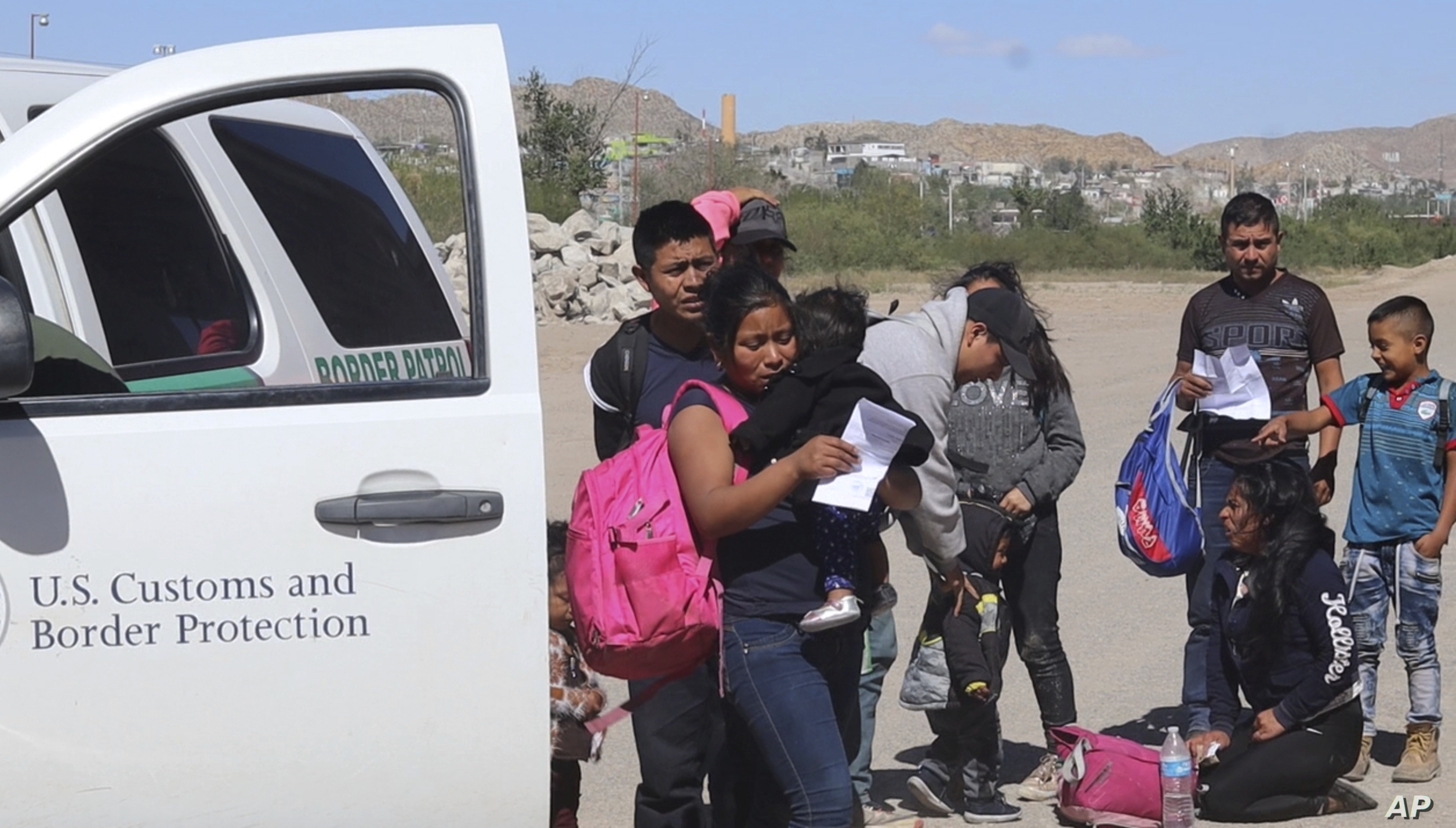
In this April 2019, frame from video, migrants turn themselves in to border agents in El Paso, Texas, after crossing the US – Mexico border.
The hateful manifesto’s author – police believe it was the shooter but investigation continues – insisted the opinions “predate Trump and his campaign for president.” But the words echoed some of the views Trump has expressed on immigration, including claiming that Democrats “intend to use open borders, free HealthCare for illegals, citizenship and more to enact a political coup by importing and then legalizing millions of new voters.”
Dayton Mayor Whaley said simply, “Everyone has it in their power to be a force to bring people together, and everybody has it in their power to be a force to bring people apart – that’s up to the president of the United States.”
Democrats vying to challenge Trump in the 2020 election have been nearly unanimous in excoriating him for rhetoric they warned has nurtured the racist attitudes of the El Paso shooter as they sought to project leadership during a fraught moment for a bruised nation.
New Jersey Sen. Cory Booker was delivering a speech on gun violence and white nationalism Wednesday at the Charleston, South Carolina, church where nine black parishioners were killed in 2015. Pete Buttigieg, the mayor of South Bend, Indiana, released a detailed plan for gun control and deterrence.
Gidley and other White House officials denounced suggestions that Trump’s rhetoric was in any way responsible for the shooting. They called it “dangerous,” ‘pathetic,” ‘disgusting.”
“It’s not the politician’s fault when somebody acts out their evil intention,” he said, pointing to other shooters who have expressed political preferences for Democratic politicians including Massachusetts Sen. Elizabeth Warren and Vermont’s Bernie Sanders.
“It is shameful that Democrats are unable to prevent themselves from politicizing a moment of national grief,” added Trump campaign spokesman Tim Murtaugh.
Trump himself, quoting one of the hosts of his favorite “Fox & Friends” show, tweeted: “Did George Bush ever condemn President Obama after Sandy Hook. President Obama had 32 mass shootings during his reign. Not many people said Obama is out of control. Mass shootings were happening before the president even thought about running for Pres.”
Warren spokeswoman Kristen Orthman said leaders have an obligation to speak out.
“Let’s be clear,” she said in a statement. “There is a direct line between the president’s rhetoric and the stated motivations of the El Paso shooter.”
Recent Pew Research Center polling found 85% of U.S. adults believe the tone and nature of political debate in the country has become more negative, with a majority saying Trump has changed things for the worse. And more than three quarters – 78% – say that elected officials who use heated or aggressive language to talk about certain people or groups make violence against those people more likely.
The Buddhist enclave of Ladakh cheered India’s move to break it away from Jammu and Kashmir state, a change that could spur tourism and help New Delhi counter China’s influence in the contested western Himalayas.
Beijing, though, criticized the announcement, made on Monday by the Indian government of Prime Minister Narendra Modi as part of a wider policy shift that also ended Jammu and Kashmir’s right to set its own laws. In a statement on Tuesday, China said the decision was unacceptable and undermined its territorial sovereignty.
Ladakh is an arid, mountainous area of around 59,146 square kilometers (22,836 square miles), much of it uninhabitable, that only has 274,000 residents. The rest of Jammu and Kashmir is roughly 163,090 square kilometres (62,969 square miles) with a population of some 12.2 million.
China and India still claim vast swaths of each other’s territory along their 3,500 km (2,173 mile) Himalayan border.
FILE – The sun sets in Leh, the largest town in the region of Ladakh, nestled high in the Indian Himalayas, India, Sept. 26, 2016.
The Asian rivals had a two-month standoff at the Doklam plateau in another part of the remote Himalayan region in 2017.
“The fact that India took this move … can be seen as one way that India is trying to counter growing Chinese influence in the region,” said Sameer Patil, a Mumbai-based fellow in international security studies at the Gateway House think-tank.
In a statement, Chinese Foreign Ministry spokeswoman Hua Chunying said China contests the inclusion of what it regards as its territory on the Indian side of the western section of the China-India border.
“India’s unilateral amendment to its domestic law, continues to damage China’s territorial sovereignty. This is unacceptable,” Hua said.
In response to a question about Hua’s statement, Indian Foreign Ministry spokesman Raveesh Kumar said on Tuesday the Ladakh decision was an internal matter.
“India does not comment on the internal affairs of other countries and similarly expects other countries to do likewise,” said Kumar, without directly mentioning China.
Patil from Gateway House said monks he interviewed in Ladakh told him China-endorsed monks had been extending loans and donations to Buddhist monasteries in the area in an apparent bid to win influence.
Reuters was not able to contact any monks in Ladakh.
“Our Own Destiny”
By announcing it would turn Ladakh into its own administrative district, the Indian government fulfilled a decades-long demand from political leaders there.
Ladakh locals were tired of being hurt or ignored because of the many years of turmoil in the Kashmir Valley resulting from separatist militant activity and the Indian military’s moves to crush them.
Local politicians and analysts expect the change to bring Ladakh out of the shadow of Kashmir, which has long been a flashpoint with Pakistan. It could also help the area pocket more government funding as it seeks to build up its roads and facilities to lure tourists.
“We are very happy that we are separated from Kashmir. Now we can be the owners of our own destiny,” Tsering Samphel, a veteran politician from the Congress party in Ladakh, said on Tuesday. He added the area felt dwarfed by Jammu and Kashmir – which is a majority Muslim area – and that the regions had little in common culturally.
In Ladakh’s city of Leh on Monday, members of Modi’s ruling Bharatiya Janata Party danced in the streets and distributed sweets, Reuters partner ANI reported.
Ladakh will be governed by a centrally-appointed lieutenant governor, handing New Delhi stronger oversight over the area.
However, while Ladakh will become a Union Territory, it will not have its own legislature – a sore point for some locals.
“Hopefully we will be getting that also, slowly,” said Samphel, 71, adding that local politicians would put that demand to New Delhi.
FILE – A Maitreya Buddha is seen at Thiskey Monastery near the town of Leh in Ladakh, India, Sept. 26, 2016.
Ladakh’s economy, traditionally dependent on farming, has benefited from tourists visiting ancient monasteries and trekking up mountain peaks.
P. C. Thakur, general manager of The Zen Ladakh hotel in Leh, hopes that dissociating from Jammu and Kashmir will further attract visitors. He expects the hotel’s occupancy to jump by up to 7 percentage points from an average of around 80-85% currently.
In Angola, young people people are learning about the history of the slave trade in the classroom, as VOA’s Mayra de Lassalette and Betty Ayoub found when they traveled to the African nation. Mayra de Lassalette narrates their report.
Four hundred years ago, the first enslaved Africans landed in what is now the United States. Those first African captives came from the Portuguese colony of Angola, brought to the shores of Virginia in 1619 by an English pirate ship that had seized them from a Portuguese slave ship. Some 6 million enslaved Africans came from Angola, most of them sent to Portugal’s colonies, though some ended up in North America. VOA’s Mayra de Lassalette and Betty Ayoub traveled to Angola where they heard accounts of the fierce resistance to the slave trade. Mayra de Lassalette narrates their report.
Japanese Prime Minister Shinzo Abe says the main cause of escalating tensions between Japan and South Korea is a loss of trust over court rulings ordering Japanese companies to compensate South Koreans for forced labor during World War II.
Japan has imposed export controls on key materials for South Korea’s semiconductor industry and moved to downgrade the country’s trade status. It has insisted that the measures were related to national security concerns and were not in retaliation for the court rulings.
Japan ruled the Korean Peninsula as a colony until the end of the war, and insists that all compensation issues were settled under a 1965 agreement normalizing ties.
Abe, responding to a question Tuesday about the escalating tensions, urged Seoul to take appropriate actions to stop the court procedures.